Reconciliation Accounting
Charge off bad debts
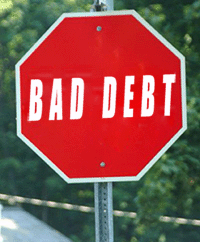
A charge off to a bad debt ensues when a company regulates that money owed to it is unlikely to be paid. In order to balance the company's ledger, the debt is ‘written off’ the books. Even though a charge off to a bad debt does not mean that the debt is no longer owed, the date of a charge off has significant value to debtors.
It is significant for debtors to know what it means when a creditor charges off a debt that has not remained paid. Numerous people believe that a charged off debt does not required to be repaid. This is a misapprehension. A charge off to a bad debt is a firm's internal way of balancing its books and to take benefit of an IRS rule. Firms continue to pursue payment for charged off debts.
Officially, a company charges off a debt for two causes. One form of a charge off is when a company reconciles its ledger in the event of a bad debt. When an outstanding debt is not paid, the creditor must reconcile the debt as a loss. A second type of charge off is when a company faces an extraordinary expense that causes a reduction in the company's assets. An unexpected expense is an expense that only happens once on an income statement. Expenses that arise as the result of a disaster that causes hardship to a company are extraordinary.
When a firm has failed to collect an outstanding debt, it should account for the loss of payment. When a bad debt is charged off, this is a time when a creditor might sell the debt to a collection agency. The cash received for the debt is considered as a sale. A creditor also can list the debt itself as an expense on its income statement. That charge off to a bad debt has a consequence on the future of the debt as it relates to the debtor.
Once a company regulates that a debt is exclusively or partly worthless, it is normally enabled to a bad debt deduction for tax purposes. With respect to partly worthless debts, a bad debt deduction might only be taken for exact debts and only to the extent charged off during the taxable year.
Effects
Debtors incline towards misinterpret the insinuations of a charge off to a bad debt. Once a creditor charges off a bad debt, the company continues to follow collections and, ultimately, it will sell the debt to a third party collector. The Fair Credit Reporting Act demands that the debt should remain removed from the debtor's credit report seven years from the date of the charge off. A charge off occurs 180 days after the main default on a payment. The federal law means that debtors have a resource with which to act against dishonest collections agents and litigators. Debtors must keep all statements and notices since creditors should report a charge off in 90 days to credit bureaus.
Disclaimer: The software content used in this page is only for customers to know about the software and not for any commercial intentions.
The main benefits of working with accountingoutsource2india are below:
Consistent Data Source – accountingoutsource2india business give you consist and precise data which can be easily used for the benefits of the decision-making desires. This in turn guarantees competence in workflow and there is no expenditure of time.
Maximize your ROI: accountingoutsource2india work give significant cost reduction and gives you high Return of asset.
High Superiority Work - Main benefits of accountingoutsource2india work is to get high quality work as per your needs.
Well-organized Data Management: accountingoutsource2india provider companies take input data from any source and give output data into digital format or as you need set-up so this provide better organization of data.
Securities, Uniformity, Rapid growth, Speed, services and improve customer satisfaction, improved presentation, Backend effective work environment these are main goal of accountingoutsource2india.
We work 24/7 days for more details feel free to contact us at any time you required.